Flawed Exodus 21:244
R&D Statement of PhD-Law Proposal 2025ed
By: Almossawi HIH (Yisrael, BS) 2024; www.1742-819x.eu & 1742-819x 2021-30)
(R&D of evolve UNESCO Project of Jerusalem Temple Mount)
Subject Matter/in the matter of: (Title also apply Alterity of legal Pedagogy & Criminology); and
Litigants’ Means of solving injustices: An impersonated Litigant shadowing Lex-Talionis Logic (1750 BC) of void Rule-of-Time & void Rule-of-Law, and acting in self-defense case vs perpetrators at an Open Court of Public Prosecution, of 1750 BC ET Hebrew Order.
Litigants with intermittent representation or no access to representation at all have received fairly limited attention in the analyses of the effects of LASPO as well as the implications of the court reform program (Leader, 2020) This research problem stems from the subjectivity of Rule-of-Law base illusive Rule-of-Time. Whose order of Law-and-order? Where? Knowingly or recklessly Judges understand the expression of when is an illusion, null or void. But, can we manage the events without the order of so-called Time? Since Rule-of-Law may have the alterity, it is known that Human lags behind nature on Rule-of-Law indexes, and including the Rule-of-Law Indicators published by the World Bank from 1998.
But, who make the guidance and where with no-when, if any? Human's exception has defied what has become known as Rule-of-Law Orthodoxy, which is about a set of subjective ideas or activities and strategies aim towards bringing about the Rule-of-Law or the business of so-called HM Court & Tribunal Services HM-CTS processing Court Procedural Rules CPR operating sensory feedback of (standard of proof) of bias fallacy of fraudulent dice base gambling.
The Rule-of-Law Orthodoxy emphasises strengthening the foundations of modern Western-style law (Tamanaha 2004, Golub 2003, and Carothers 2003). This approach continues to prevail despite a shortage of knowledge, captured by the likes of Muller (2008), Krygier (2007), Zimmerman (2007) and Carothers (2003), on how the Rule-of-Law develops in societies and how it can be stimulated other than by copying institutional forms. If (a demonstration is successful however), then (alternative argument would have implications for legislative policy formulation and practice by challenging the bases of current strategies for the illusive Rule-of-Law).
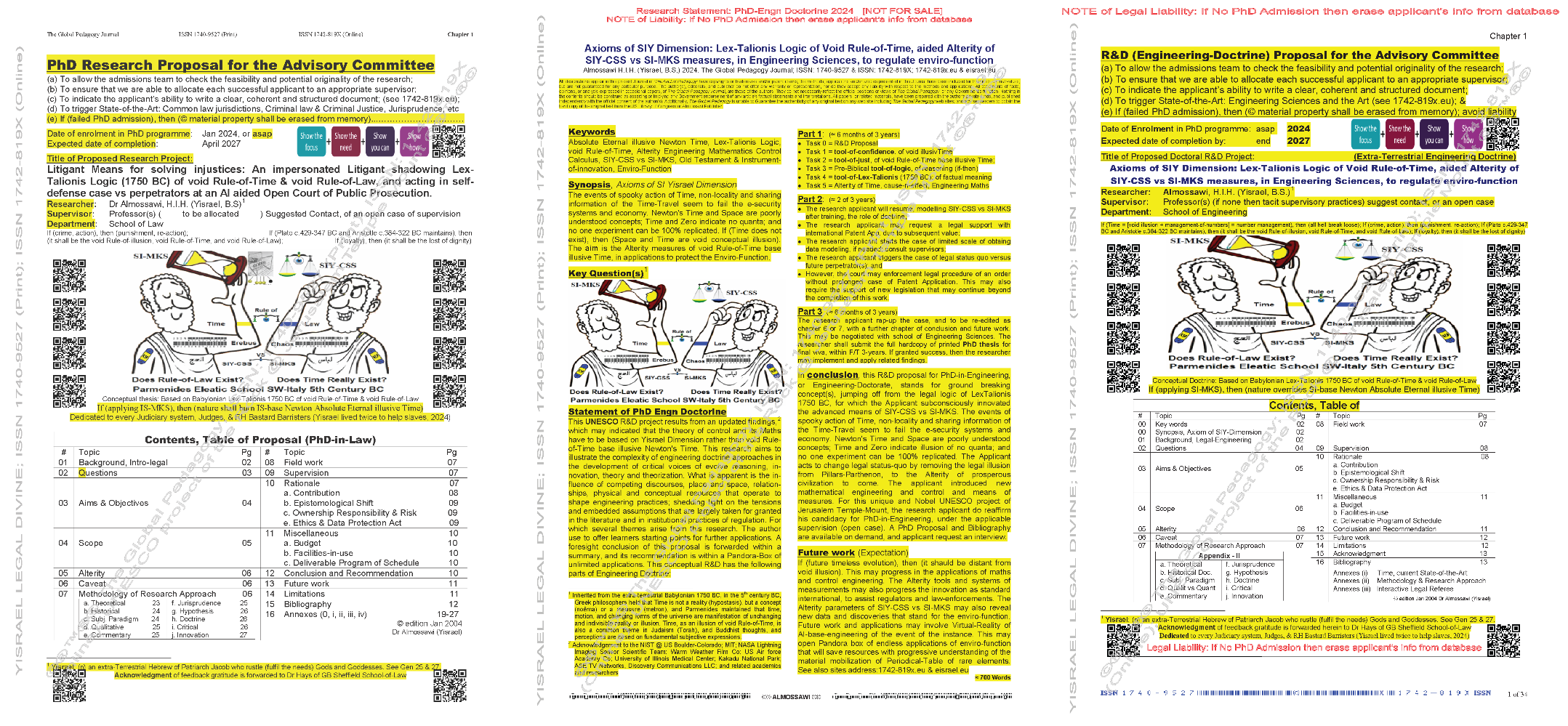
Thus, is there any Standard International? Is it in the extra-Terrestrial order of Yisrael Legal Divine? Therefore, in any individual window of memory of what is expressed as nature, primary questions may arise, as in the above pre-Biblical illustration 500 BC, stems from original Babylonian tablets 1750 BC of Lex-Talionis which were discovered and catalogued by Almossawi HIH (Yisrael, BS) 2009 at Meso-Hebrew Babylon (1742-819x & 1742-819x.eu 2021). This may raise the problem of demonstrating that the illusive Rule-of-Time may be built on a type of law other than modern law, so-called Rule-of-Law.
The problem of Alterity may translate into the present quantitative and analytical research of facts of variant nature. The problem may also translate into the above research questions of Rule-of-Law, followed by legal regulatory analytical and physical approach. If (in tackling the questions it will first and foremost require the multi- and inter-disciplinary approaches), then (it shall encompassing Order and behavioral sciences of evolve reasoning). To that we must devote ourselves with greatest urgency (Muller, 2008).
---------------------------------------------------------------
Leader, K. 2022. Written Evidence. Lecturer at York Law School. York University. (Leader left York University due to Law-School malfunction)
Leader, K. 2019. Litigants in Person in the Civil Justice System PhD Thesis, Department of Law, London School of Economics and Political Science: http://etheses.lse.ac.uk/3763/.
Leader, K. 2020. “From Beargardens to the County Court: Creating the Litigant in Person,” Cambridge Law Journal 79.2: ttps://www.cambridge. org/core/journals/cambridge-lawjournal/article/from-bear-gardens-to-the-county-court-creating-the-litigant-inperson/8D7DB9CCA07F4E257AD5C46886842D85.
McKeever, 2020. “Remote Justice? Litigants in Person and Participation in Court Processes during Covid-19,” Commentary, Modern Law Review.
Sefton (2005), Unrepresented litigants in first instance proceedings (Department for Constitutional Affairs, London). See next pgs of Proposals (x2) & Bibliography.